Step 01
Start with the guide
SDIS-00 sets the purpose, terminology, citation rules and the registry of identifiers used across the series.
A complete technical series on the systems, silicon and policy that make national AI independence possible — twelve reports and a series guide, each with a persistent DOI on Zenodo.
The series
The Sovereign Digital Infrastructure Series (SDIS) is D-AI's open technical corpus — twelve reports plus a series guide by Bijan Burnard, published with persistent identifiers on Zenodo.
Together they define how a nation keeps control of data, compute, operations and governance: sovereign cloud, residency, identity, semiconductors, standards, resilience, cybersecurity, financial rails and public-sector procurement.
View the D-AI Research community on ZenodoStart with the registry, work through each layer, then use the capstone as the operating architecture.
Step 01
SDIS-00 sets the purpose, terminology, citation rules and the registry of identifiers used across the series.
Step 02
Each paper covers one layer of national digital infrastructure — from cloud and data to identity, compute, security and procurement.
Step 03
SDIS-12 synthesizes the series into a single reference architecture and a maturity roadmap for institutions building from a low baseline.
SDIS-00 is the index for the twelve technical reports — methodology, terminology, versioning and the DOI registry.
SDIS-00 accompanies the twelve technical reports of the Sovereign Digital Infrastructure Series. It states the purpose and scope of the series, documents the research methodology and core terminology used across all twelve papers, and serves as the registry of persistent identifiers assigned to each publication.
Read in order. Each paper is a standalone briefing with a persistent DOI; together they form the Sovereign Stack.
Definitions, drivers, and a reference framework for national digital infrastructure.
Technical patterns for jurisdictional control over compute, storage, and operations.
Technical and legal mechanisms for controlling where data lives and moves.
Architectures for national eID, wallets, and trust frameworks.
AI infrastructure, semiconductor dependency, and strategic autonomy in the GPU era.
Avoiding sovereign fragmentation through shared technical protocols.
Threat models and continuity design for sovereign digital systems.
Zero trust architectures and post-quantum readiness for national systems.
Technical architecture for state-issued digital money.
Governance models for sovereign technology adoption.
Treaties, adequacy frameworks, and technical enforcement of data flow rules.
A reference architecture for national digital infrastructure.
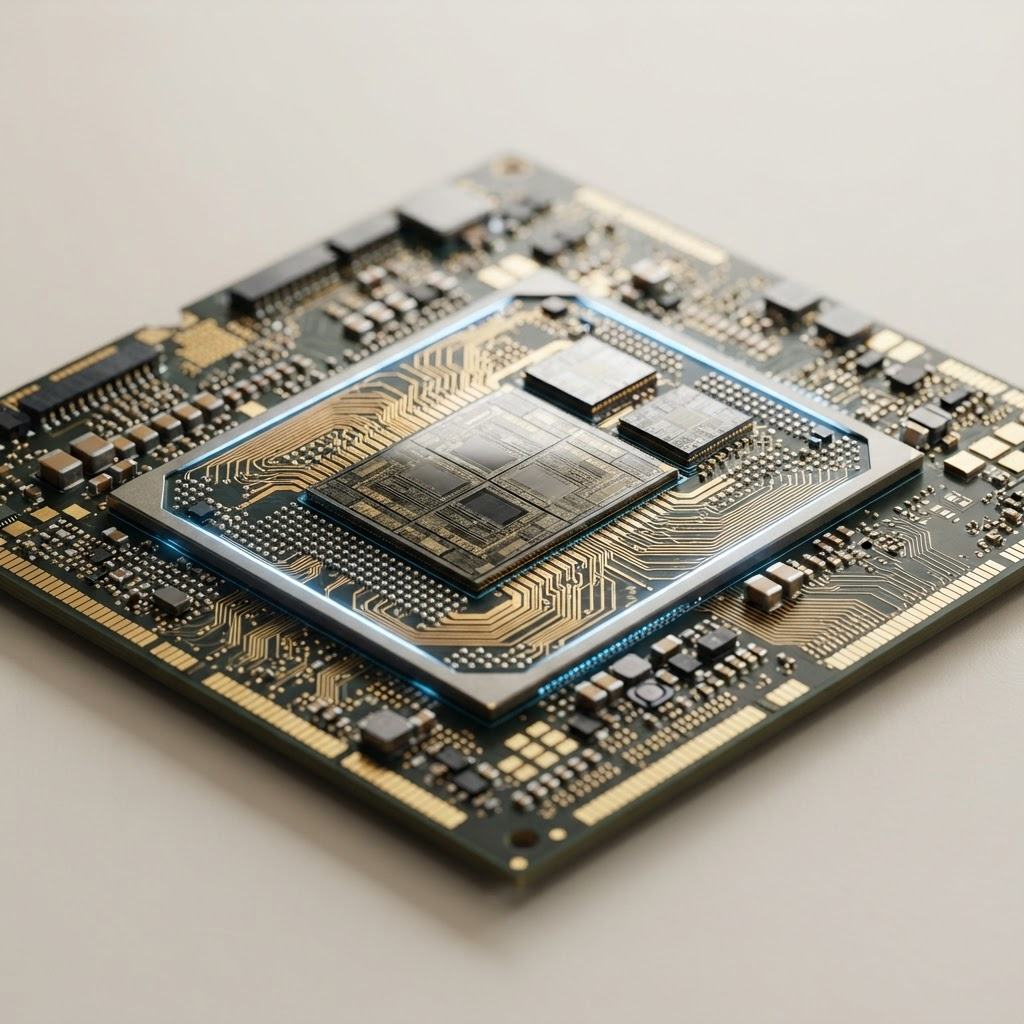
D-AI's frontier silicon-photonics program reimagines the AI accelerator — replacing electrons with photons to break the power and heat ceilings that limit national-scale intelligence.
Compute per watt vs. leading electronic accelerators
On-chip matrix-multiply latency at the speed of light
Reduction in interconnect heat generation
Wavelengths multiplexed per waveguide for parallel math
Matrix multiplication — the core operation of every neural network — is performed by interfering beams of light in silicon photonic meshes, eliminating the resistive losses that cap electronic chips.
By multiplexing multiple wavelengths through a single waveguide, a photonic tensor core executes many independent operations simultaneously, multiplying throughput without shrinking transistors.
At gigafactory scale, a 10× efficiency gain translates into hundreds of megawatts saved — the difference between a sovereign program that is financeable and one that is not.
Photonic dies can be manufactured on mature nodes rather than bleeding-edge fabs, opening a realistic route to in-country production and supply-chain independence.
Silicon photonic mesh demonstrating optical matrix multiplication with electronic control plane.
Co-packaged optics bonded to electronic SRAM and control logic for a complete accelerator.
Rack-deployable module integrated into the LLM Box and gigafactory compute fabric.